Hitting the Bullseye
The Industry at a Glance
- Home to the Duck Hunting Capital of the World: Stuttgart, Arkansas
- 3rd in economic output per capita in the arms and ammunition industry (Source: National Shooting Sports Foundation)
- 3rd Most Gun-Friendly State (Source: Ammo.com)
- 3rd Largest Exporter of Firearms and Ammunitions in the U.S. (Source: Global Trade Atlas, 2023)
- 8 pro-gun bills passed into law during the 2023 legislative session
- $2.3B in economic output
INFRASTRUCTURE
- Three U.S. interstates connecting east and west coasts, and the Canada and Mexico borders
- 16,418 miles of state and U.S. Highways – 12th largest system in the U.S.
- Eight intermodal freight facilities with four riverports
- 2,542 miles of Class 1 rail systems
- #3 in the nation with 1,000 miles of inland, navigable waterways
- Approximately 100 public airports including Clinton National, Northwest Arkansas National, and close proximity to Memphis International and the Fed-Ex hub
Well-trained workforce
- 7th highest percentage of manufacturing employment (Source: Business Facilities)
- 1.36M skilled and trained workforce
- 12% of Arkansas’ workforce is employed in manufacturing
- 8,400+ people employed in the arms and ammunitions industry.
Business Climate in Arkansas
- #3 Least Expensive State for Starting a Small Business (Source: SimplifyLLC)
- #2 on the Cost of Living Index (Source: C2ER)
- 7th highest percentage of manufacturing employment (Source: Business Facilities)
EDUCATION
- 50 colleges, universities & 2-year colleges throughout Arkansas
- 2,100+ engineering degrees awarded each year
- 150k+ students enrolled at an Arkansas institution of higher learning
- Black River Technical College is 1 of only 11 accredited gunsmithing programs in the US – and the only institution connected to a law enforcement training academy.
- Ozarka College's Precision Machining program prepares students for a career in manufacturing, providing them with skills in manual machining and operation of CNC mills and lathes.
Firearms & Ammunition Industry
Executive Overview

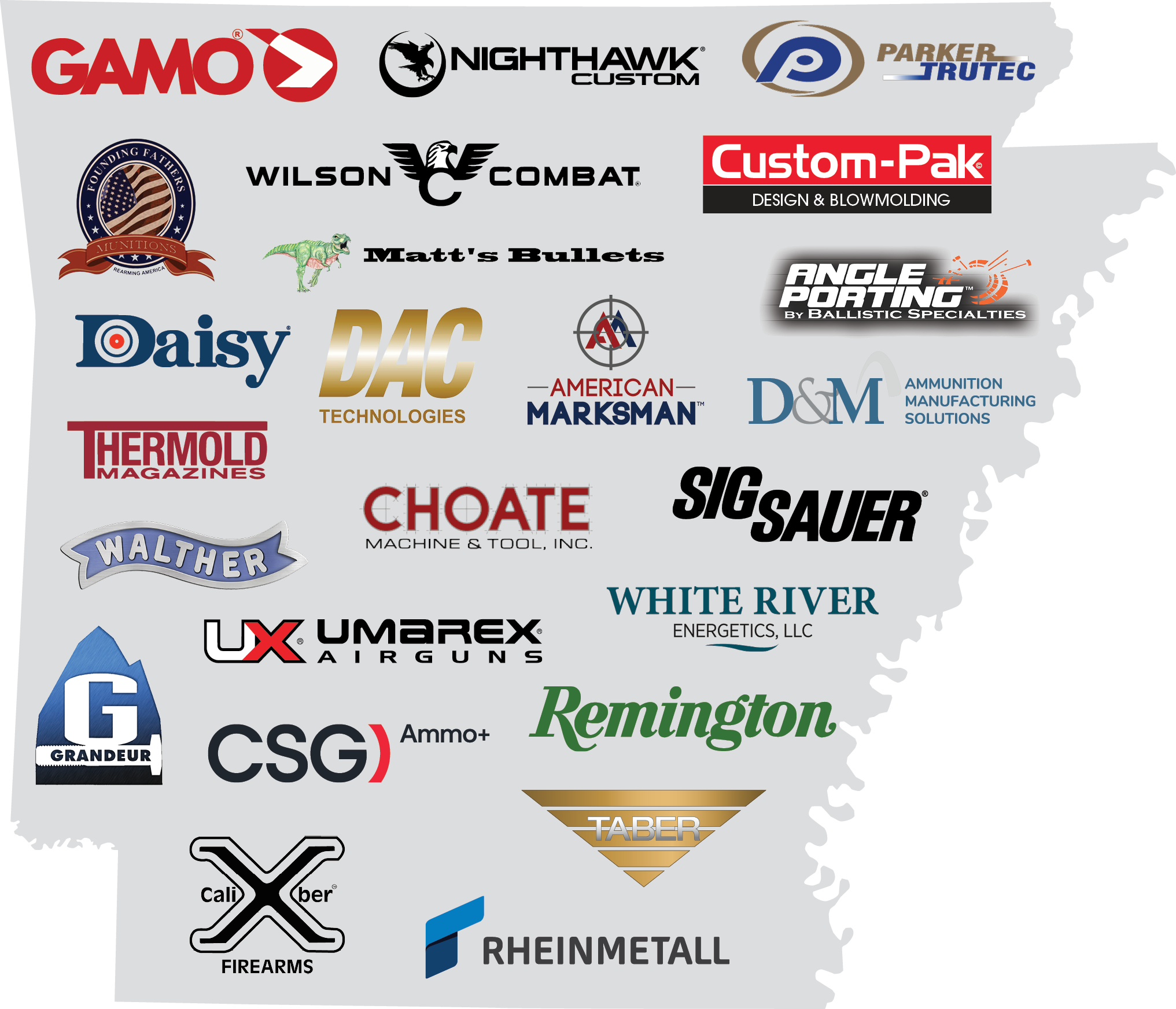
Arkansas is Primed for Success
Home to the duck hunting capital of the world and the 3rd most gun-friendly state, Arkansas is the natural choice for firearms and ammunition companies to find success.
Watch MoreFrom the newsroom
LaCroix Precision Optics Expands in Batesville, Arkansas, Creating 107 New Jobs
LaCroix Precision Optics is expanding in Batesville, Arkansas, creating 107 new jobs.
ReadWhite River Energetics Expands in Des Arc, Creates 100 New Jobs
White River Energetics is expanding in Des Arc, creating 100 new jobs.
ReadAfter Meeting with Governor Sanders During Her European Trade Mission, Walther Announces $30M Expansion in Fort Smith, Arkansas
Walther is expanding in Fort Smith, Arkansas with a capital investment of up to $30 millio...
Readfrom the blog
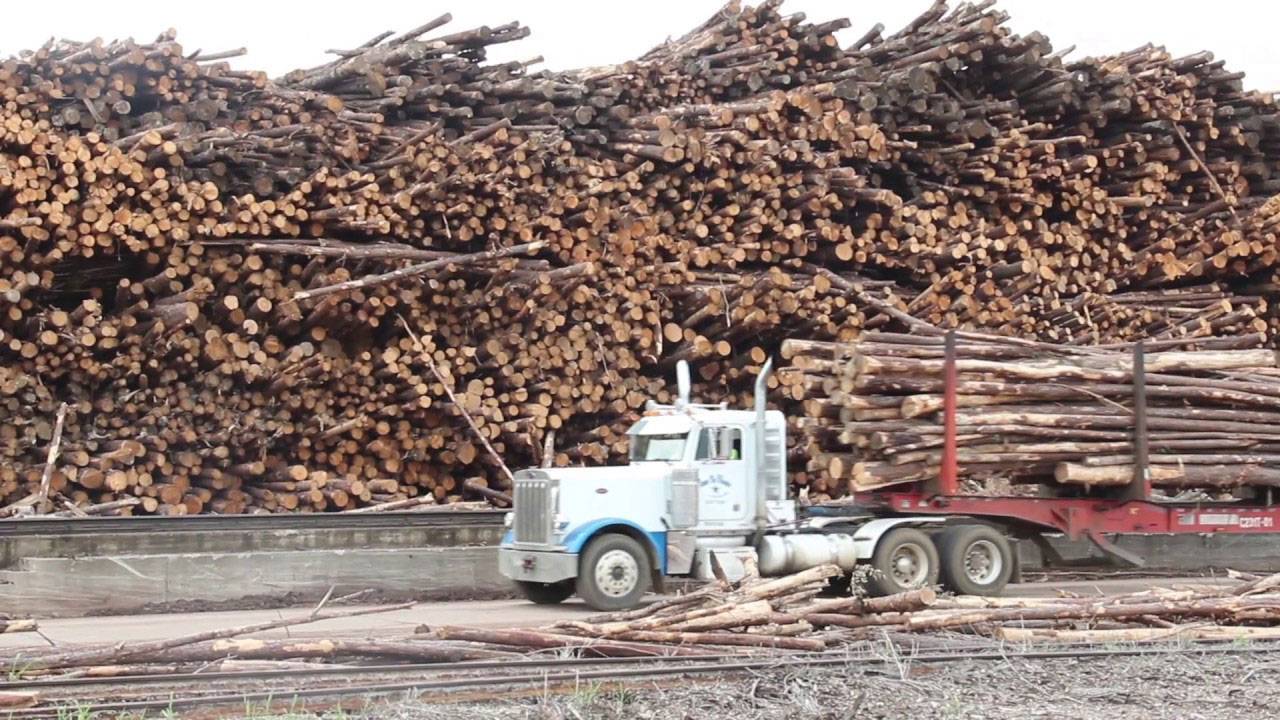
Forestry Leadership Leads to Global Interest in Arkansas Timber
April 27, 2017For more than 130 years, the timber industry has been a major driver of Arkansas’ economy. In recent years, the industry has enjoyed even more growth.
Arkansas’ forest land consists of approximately 19 million acres, covering more than half of the state. Because of responsible stewardship of the land, forests in Arkansas have more trees and are healthier than the forests of more than 100 years ago.
“We understand the forest,” says Arkansas Governor Asa Hutchinson. “It’s not a new phenomenon here.”
Max Braswell, executive director of the Arkansas Forestry Association, says it makes a difference when 83 percent of the forest land is privately owned, because private landowners rely on the forest for their livelihood.
“Foresters are the original green guys,” said Braswell. “It’s not just a catch phrase; it’s a way of life for regular people who on a daily basis commit their lives to doing the right things on the landscape.”
That growth and care for the land has created one of the best wood baskets in the country and, perhaps, the world. Hardwoods, such as oak and hickory, account for 41 percent of the timber in the state, while pine is responsible for 31 percent of the cover.
“We have an abundance of supply,” Gov. Hutchinson said. “But we also have the capability of getting those forest products into the marketplace with the major east-west and north-south interstate networks and our modern rail systems.”
The supply and proximity to major consumer markets makes Arkansas an attractive place to do business.
Conifex, a Canadian-based forestry services company, recently announced that it purchased an abandoned mill in El Dorado in south Arkansas and will soon be producing lumber products. A friendly corporate tax rate system and a recently reduced income tax rate along with business affordability are reasons the company cited for expanding into Arkansas.
“We selected this location because we will have affordable delivery costs to important lumber consuming markets such as Texas, Florida and the east coast states,” said Ken Shields, CEO of Conifex. “There are both a strong forest products culture here and a good workforce.”
Arkansas timber and timber products, however, are exported all over the world.
Australia, Mexico and Spain are Arkansas’ major trading partners for forestry products such as timber and logs. Canada, Mexico and China are the top three destinations for sawmill and wood products. And, Canada, Mexico and Japan receive a bulk of the paper products produced in the state.
More than 28,000 people are directly employed by the timber industry in Arkansas – a workforce that Bob Grygotis, general manager of Domtar in Ashdown, says is changing.
“We’re looking for a higher level of workforce coming into the mill than what was required 20 years ago,” said Grygotis. “Our technology is advanced, and we have computer controls on our equipment. So, it’s not so much about the muscle anymore, it’s about what is between the ears.”
A pipeline to a technology-based workforce is one of the reasons Chinese government-owned Sun Paper made the decision in 2016 to build a $1.3 billion paper mill near Arkadelphia in southwest Arkansas. The mill will utilize forest bio-products which includes logging leftovers, dead wood and non-commercial trees that are thinned from crowded and fire-prone forest land. At capacity, the plant will have 250 employees making an average annual salary of $52,000.
Forest health, a modern transportation infrastructure for ease of delivery, and an available highly trained workforce are Gov. Hutchinson’s main selling points for attracting the timber industry to the state.
“We’ve got the supply. We’ve got an abundance of natural timber that can be utilized for a variety of purposes. We have the workforce that is experienced in the industry, and we have access to the marketplace. All of those are reasons why Arkansas is the perfect fit for expansion in the forest products industry,” said Gov. Hutchinson.
Arkansas’ Wood Basket By the Numbers








At AEDC, we know economic advancement doesn’t happen by accident. We work strategically with businesses and communities to create strong economic opportunities, making Arkansas the natural choice for success. Here are some examples of businesses that are thriving!






Arkansas offers a range of competitive incentives for businesses looking to open, expand or relocate.
