Hitting the Bullseye
The Industry at a Glance
- Home to the Duck Hunting Capital of the World: Stuttgart, Arkansas
- 3rd in economic output per capita in the arms and ammunition industry (Source: National Shooting Sports Foundation)
- 3rd Most Gun-Friendly State (Source: Ammo.com)
- 3rd Largest Exporter of Firearms and Ammunitions in the U.S. (Source: Global Trade Atlas, 2023)
- 8 pro-gun bills passed into law during the 2023 legislative session
- $2.3B in economic output
INFRASTRUCTURE
- Three U.S. interstates connecting east and west coasts, and the Canada and Mexico borders
- 16,418 miles of state and U.S. Highways – 12th largest system in the U.S.
- Eight intermodal freight facilities with four riverports
- 2,542 miles of Class 1 rail systems
- #3 in the nation with 1,000 miles of inland, navigable waterways
- Approximately 100 public airports including Clinton National, Northwest Arkansas National, and close proximity to Memphis International and the Fed-Ex hub
Well-trained workforce
- 7th highest percentage of manufacturing employment (Source: Business Facilities)
- 1.36M skilled and trained workforce
- 12% of Arkansas’ workforce is employed in manufacturing
- 8,400+ people employed in the arms and ammunitions industry.
Business Climate in Arkansas
- #3 Least Expensive State for Starting a Small Business (Source: SimplifyLLC)
- #2 on the Cost of Living Index (Source: C2ER)
- 7th highest percentage of manufacturing employment (Source: Business Facilities)
EDUCATION
- 50 colleges, universities & 2-year colleges throughout Arkansas
- 2,100+ engineering degrees awarded each year
- 150k+ students enrolled at an Arkansas institution of higher learning
- Black River Technical College is 1 of only 11 accredited gunsmithing programs in the US – and the only institution connected to a law enforcement training academy.
- Ozarka College's Precision Machining program prepares students for a career in manufacturing, providing them with skills in manual machining and operation of CNC mills and lathes.
Firearms & Ammunition Industry
Executive Overview
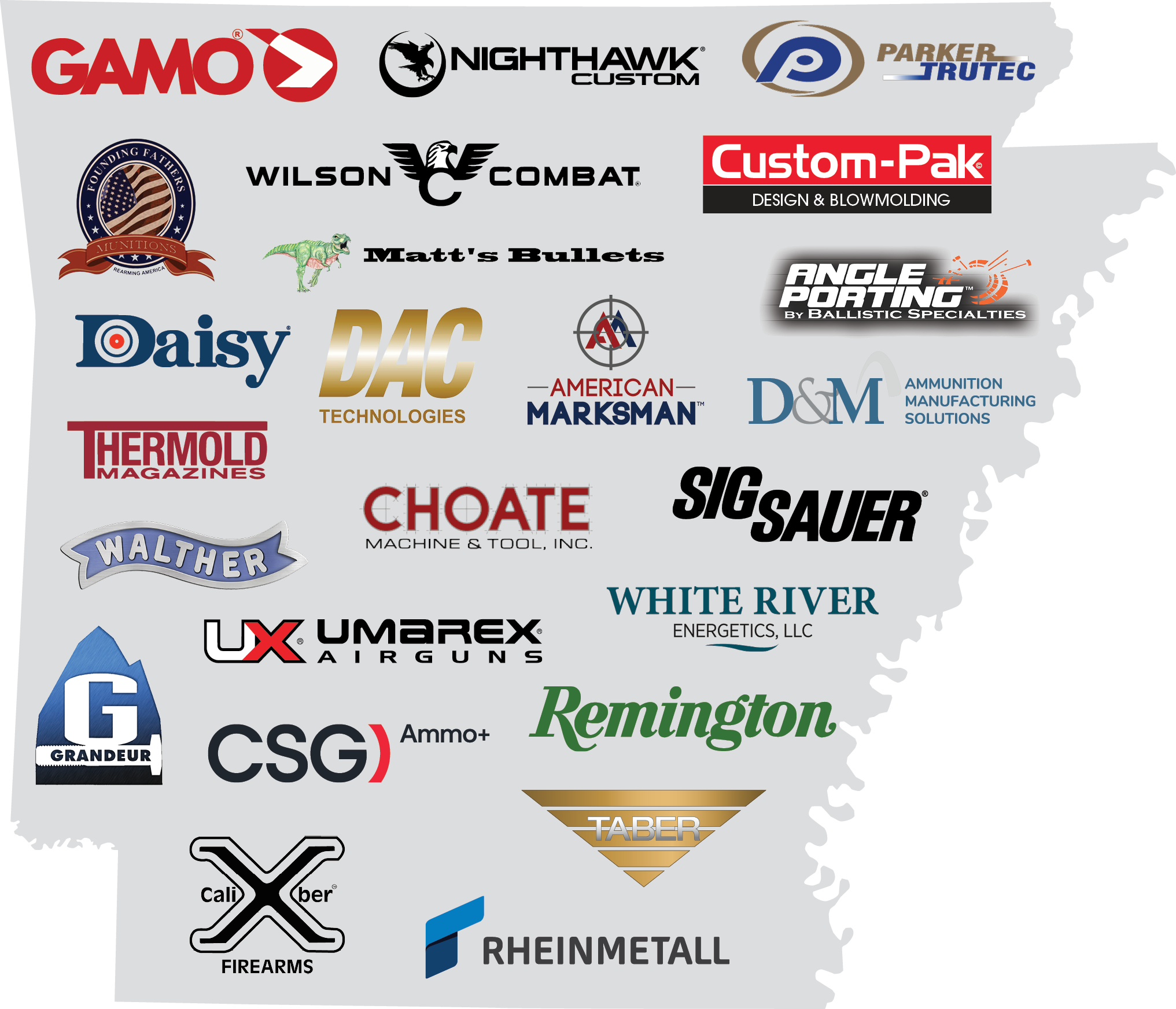
Arkansas is Primed for Success
Home to the duck hunting capital of the world and the 3rd most gun-friendly state, Arkansas is the natural choice for firearms and ammunition companies to find success.
Watch MoreFrom the newsroom
LaCroix Precision Optics Expands in Batesville, Arkansas, Creating 107 New Jobs
LaCroix Precision Optics is expanding in Batesville, Arkansas, creating 107 new jobs.
ReadWhite River Energetics Expands in Des Arc, Creates 100 New Jobs
White River Energetics is expanding in Des Arc, creating 100 new jobs.
ReadAfter Meeting with Governor Sanders During Her European Trade Mission, Walther Announces $30M Expansion in Fort Smith, Arkansas
Walther is expanding in Fort Smith, Arkansas with a capital investment of up to $30 millio...
Readfrom the blog
Arkansas Company Drives Advancements in Manufacturing Technology
September 18, 2018Manufacturing has come a long way in recent years with remarkable developments in the equipment used in factories, advancements in the maintenance of that equipment, and the Internet of Things (IoT) and artificial intelligence (AI) becoming a vital part of the industry. These innovations have increased the ability to provide preventative and predictive maintenance to both greatly reduce downtime and increase productivity.
Arkansas is home to one of the nation’s first “smart” factories, where AI and IoT connectivity play an integral role in the vast majority of the company’s operations. Big River Steel, located in Osceola, Arkansas, in collaboration with San Francisco-based enterprise AI company Noodle.ai., recently developed the first smart steel production facility. Big River Steel opened its $1.3 billion, 1300-acre steel mill last year, transforming the industry using advanced manufacturing practices. The mill’s primary operations involve scrap metal recycling and steel production designed to emphasize environmental resourcefulness and technological advancement.
The smart facility’s industrial operations run on a platform developed by Noodle.ai called the BEAST (Beast Enterprise AI Super Computing Technology). This interface optimizes a variety of functions throughout the mill, using its predictive AI engines. “This mill possesses a rich trove of sensor data for our platform to leverage, allowing us to help unlock breakthrough improvements in areas such as maintenance planning, production line scheduling, logistics operations and environmental protection,” says Stephen Pratt, CEO of Noodle.ai.
Using these sensors, control systems and machine learning-based optimization, Big River Steel has improved the practice and profit of steelmaking. There are six ways in which Big River uses machine learning: demand prediction, sourcing and inventory management, scheduling optimization, production optimization, predictive maintenance and outbound transportation optimization. By integrating these applications, the company has improved operations, yielding increased performance and profitability.
Arkansas’ economy relies heavily on manufacturing because of the number of jobs and economic opportunities the sector creates. Although manufacturing jobs have decreased because of automation, the jobs are now both safer and higher paying. And for every manufacturing job created, another three to four jobs develop in supporting fields.
With the new types of equipment, technologies and concepts within the industrial manufacturing environment, there has been a shift in the skills required by workers to make it all happen. It is clear the optimal mix of skills and workers on today’s factory floor is a joint effort: experienced workers with functional knowledge of machine tools must collaborate with younger workers who are tech-savvy and are able to effectively use and maximize today’s advanced equipment and techniques.
Today’s manufacturing jobs aren’t what they used to be. Factories are cleaner, more efficient, technology-driven operations built for high performance, productivity and worker satisfaction. With the developments in technology, careers in the field have become extremely high-tech. Partnering with technical education entities allows decision-makers to enlighten young people about the new factory environment, including all of the excitement and potential for development available. Once the right young workers are recruited and hired, ongoing development of these individuals through continuous training is key.
To learn more about manufacturing advancements in Arkansas, sign up for our newsletter.







At AEDC, we know economic advancement doesn’t happen by accident. We work strategically with businesses and communities to create strong economic opportunities, making Arkansas the natural choice for success. Here are some examples of businesses that are thriving!





Arkansas offers a range of competitive incentives for businesses looking to open, expand or relocate.
